research
FoMo-FD: Flow-Matching World Models for Surgical Robot Failure Detection Preprint ↗
Feb 2026 – Jul 2026
This project studied runtime detection of low-level execution failures in surgical robot imitation policies without requiring failure data for training. Rather than assuming predefined failure types, we detect whether the realized visual dynamics over a recent execution window deviate from the nominal dynamics expected under the commanded actions.
I developed FoMo-FD, an action-conditioned flow-matching latent world model that predicts visual dynamics over temporal windows. Failure signals are obtained through inverse transport between expected and observed dynamics, with detection thresholds determined by conformal calibration.
Z. Huang, Y. Cai, A. Patel, M. Hajiha, B. Browne, and Y. Chen, “Failure Detection for Surgical Robot Imitation Policies via Flow-Matching World Modeling,” arXiv preprint arXiv:2607.27511, 2026.
Autonomous Self-Reconfiguration Planning for Continuum Modular Robots Paper ↗ Code ↗
Apr 2025 – Jan 2026
This project studied autonomous self-reconfiguration of modular self-reconfigurable continuum robots (MSRCR), where planning must jointly reason over discrete configuration changes and continuous deformation while maintaining physical feasibility.
I developed a geometric and topological representation of robot configurations and formulated self-reconfiguration as a task and motion planning problem over configuration manifolds and reconfiguration actions. Based on this formulation, I proposed HEART-MCTS for hierarchical task planning and integrated Atlas-RRT* for motion planning within constriant manifolds.
This was a really fun collaboration with Yilin Cai that led to our paper in Science Advances.
Y. Cai*, Z. Huang*, Y. Wang, H. Xu, and Y. Chen, “Evolutionary Diversification via Modular Compliance for Self-Reconfigurable Continuum Robots,” Science Advances, vol. 12, eaeg9191, 2026. *These authors contributed equally to this work.
Teleoperated Mobile Nursing Robot in the Intensive Care Unit
Apr 2024 – Oct 2024
This project explored the use of a mobile manipulator for assisting nursing tasks in an intensive care unit (ICU). We deployed a Stretch 2 robot in a clinical environment and recorded demonstrations of representative nursing workflows for an HRI study.
I developed a custom teleoperation interface and conducted teleoperated task demonstrations in the ICU. The study investigated nurses’ perceptions and acceptance of robotic assistance in workflows.
Ultrasound-Guided Robotic Needle Insertion
Sep 2023 – Jan 2024
Ultrasound-guided robotic needle insertion can improve targeting in minimally invasive procedures. This preliminary study explored the feasibility of integrating robotic needle insertion, ultrasound imaging, and respiratory motion simulation in a single experimental setup.
I built a dual-arm robotic needle insertion system together with an XY motion platform to emulate respiratory motion, and conducted insertion experiments during periods of relative target quiescence. The prototype was used to validate the overall experimental workflow.
Body-Mounted MR-Conditional Robot for Minimally Invasive Liver Intervention Paper ↗
Jan 2023 – Sep 2023
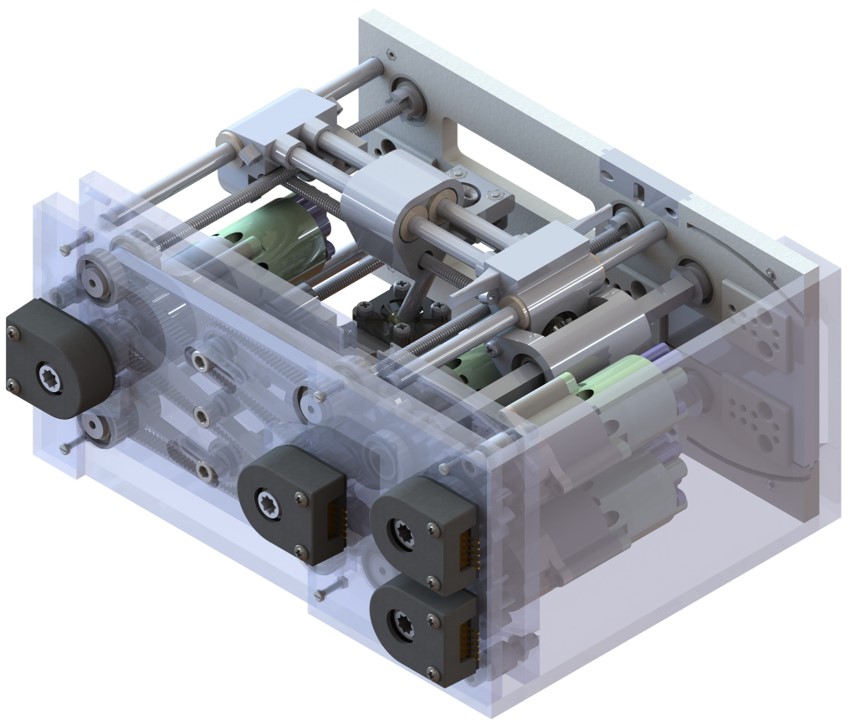
MRI-guided liver interventions require accurate needle positioning within the highly constrained bore of a closed-bore MRI scanner. This project developed a body-mounted four-DOF MR-conditional robot for minimally invasive liver intervention.
I designed and integrated the mechanical structure and mechatronic control system, including a two-layer positioning mechanism and pneumatic actuation. I also performed kinematic modeling, workspace analysis, and experimental validation of the system.
Z. Huang, A. L. Gunderman, S. E. Wilcox, S. Sengupta, J. Shah, A. Lu, D. Woodrum, and Y. Chen, “Body-Mounted MR-Conditional Robot for Minimally Invasive Liver Intervention,” Annals of Biomedical Engineering, vol. 52, no. 8, pp. 2065–2075, 2024.
Optimal Geometric Design of Concentric Tube Robots for Intracerebral Hemorrhage Removal Paper ↗
Sep 2022 – Jan 2023
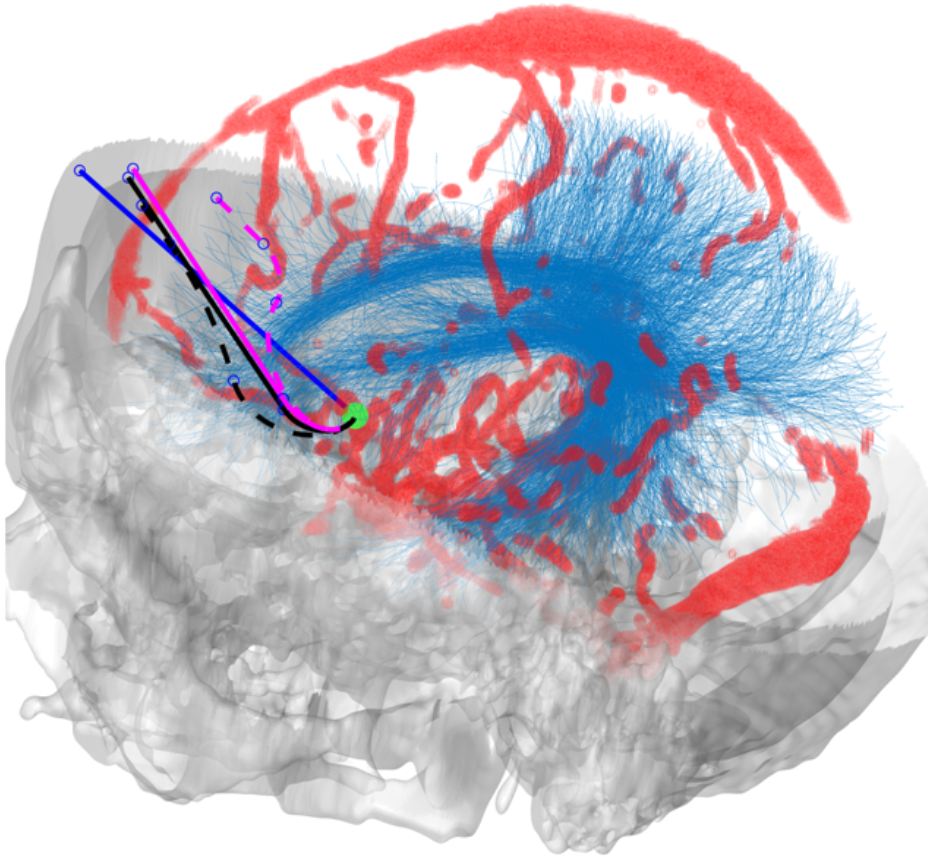
Intracerebral hemorrhage evacuation requires reaching deep targets while avoiding critical anatomical structures. This project investigated the optimal geometric design of concentric tube robots for safe access to hemorrhage regions.
I developed geometric models and optimization methods for concentric-tube robot design, representing tube shapes using parameterized helices and optimizing robot configurations under anatomical constraints.
Z. Huang, H. Alkhars, A. Gunderman, D. Sigounas, K. Cleary, and Y. Chen, “Optimal Concentric Tube Robot Design for Safe Intracerebral Hemorrhage Removal,” Journal of Mechanisms and Robotics, vol. 16, no. 8, 081005, 2024.